




 9810155689
 bdplus2001@yahoo.co.in
Posted By: Dr. Brahm Datt Pathak on 13 Sep 2026
If you have been advised to undergo hernia surgery, you may now be faced with another question:
Should I choose laparoscopic or robotic hernia surgery?
Robotic surgery has attracted considerable attention in recent years. Patients often assume that because a robotic system is newer and technologically advanced, it must automatically provide a better result than conventional laparoscopic surgery.
The reality is more nuanced.
Both laparoscopic and robotic hernia repair are minimally invasive approaches. Both allow a surgeon to repair a hernia through small incisions rather than the larger incision traditionally associated with open surgery. Both can provide excellent outcomes when used appropriately.
The important question, therefore, is not simply:
“Which technology is better?”
It is:
“Which approach is more appropriate for my particular hernia?”
The answer depends on the type of hernia, its size and complexity, whether it has been operated on before, the patient’s overall health, the surgical technique required and, importantly, the surgeon’s experience with that technique.
This article explains the differences between laparoscopic and robotic hernia surgery, their advantages and limitations, and how a surgeon decides which approach may be appropriate.
First, What Exactly Is a Hernia?
A hernia occurs when tissue or an internal organ pushes through a weak area in the muscle or connective tissue that normally contains it.
Patients often notice a lump or bulge that becomes more prominent while:
- Standing
- Coughing
- Sneezing
- Lifting something heavy
- Exercising
- Straining during bowel movements
Some hernias cause little discomfort initially, while others produce pain, heaviness, dragging sensation or increasing difficulty with everyday activities.
Different types of hernias occur in different anatomical locations.
Inguinal hernia
An inguinal hernia occurs in the groin and is one of the most common types of hernia.
Umbilical hernia
This occurs around the belly button.
Incisional hernia
An incisional hernia develops through or near the scar of a previous abdominal operation.
Ventral hernia
This broadly refers to hernias occurring through the abdominal wall.
Recurrent hernia
A hernia that develops again after a previous repair is called a recurrent hernia.
Hiatal hernia
This is different from an external abdominal-wall hernia. Part of the stomach moves upward through an opening in the diaphragm into the chest.
Because hernias vary considerably, there is no single operation that is ideal for every patient.
Does Every Hernia Need Surgery?
Not necessarily immediately.
Some patients with small, minimally symptomatic hernias may be managed with observation in appropriate circumstances.
However, a hernia generally does not repair the underlying defect by itself.
If symptoms are increasing, the hernia is enlarging, everyday activities are affected or there is concern about complications, surgery may be recommended.
A surgeon needs to assess:
- Type of hernia
- Size
- Symptoms
- Reducibility
- Previous operations
- Overall health
- Risk of complications
The decision to operate should therefore be individualised.
What Is Laparoscopic Hernia Surgery?
Laparoscopic surgery is a well-established minimally invasive technique.
Instead of making one large incision directly over the hernia, the surgeon makes several small incisions.
A laparoscope—a thin instrument with a camera—is introduced through one of these openings. The camera sends a magnified image to a monitor.
Long, specialised surgical instruments are introduced through the other ports.
The surgeon performs the operation while viewing the surgical field on the monitor.
For many abdominal-wall and groin hernias, the defect is repaired and a surgical mesh may be positioned to reinforce the weakened area when clinically appropriate.
What Is Robotic Hernia Surgery?
Robotic hernia repair is also minimally invasive.
Small ports are placed in the abdomen, but instead of directly manipulating conventional laparoscopic instruments at the operating table, the surgeon controls robotic instruments from a surgical console.
It is important to clarify a common misconception:
The robot does not perform the operation independently.
The surgeon remains in complete control of the procedure.
The robotic platform translates the surgeon’s hand movements into movements of specialised instruments inside the patient’s body.
Modern robotic systems can provide:
- Magnified three-dimensional visualisation
- Articulating instruments
- Fine instrument movement
- Improved dexterity in confined areas
- Greater freedom of movement for intracorporeal suturing
These technical characteristics can be useful in certain operations, particularly when complex dissection or reconstruction is required.
However, technological sophistication alone does not mean that every hernia should be repaired robotically.
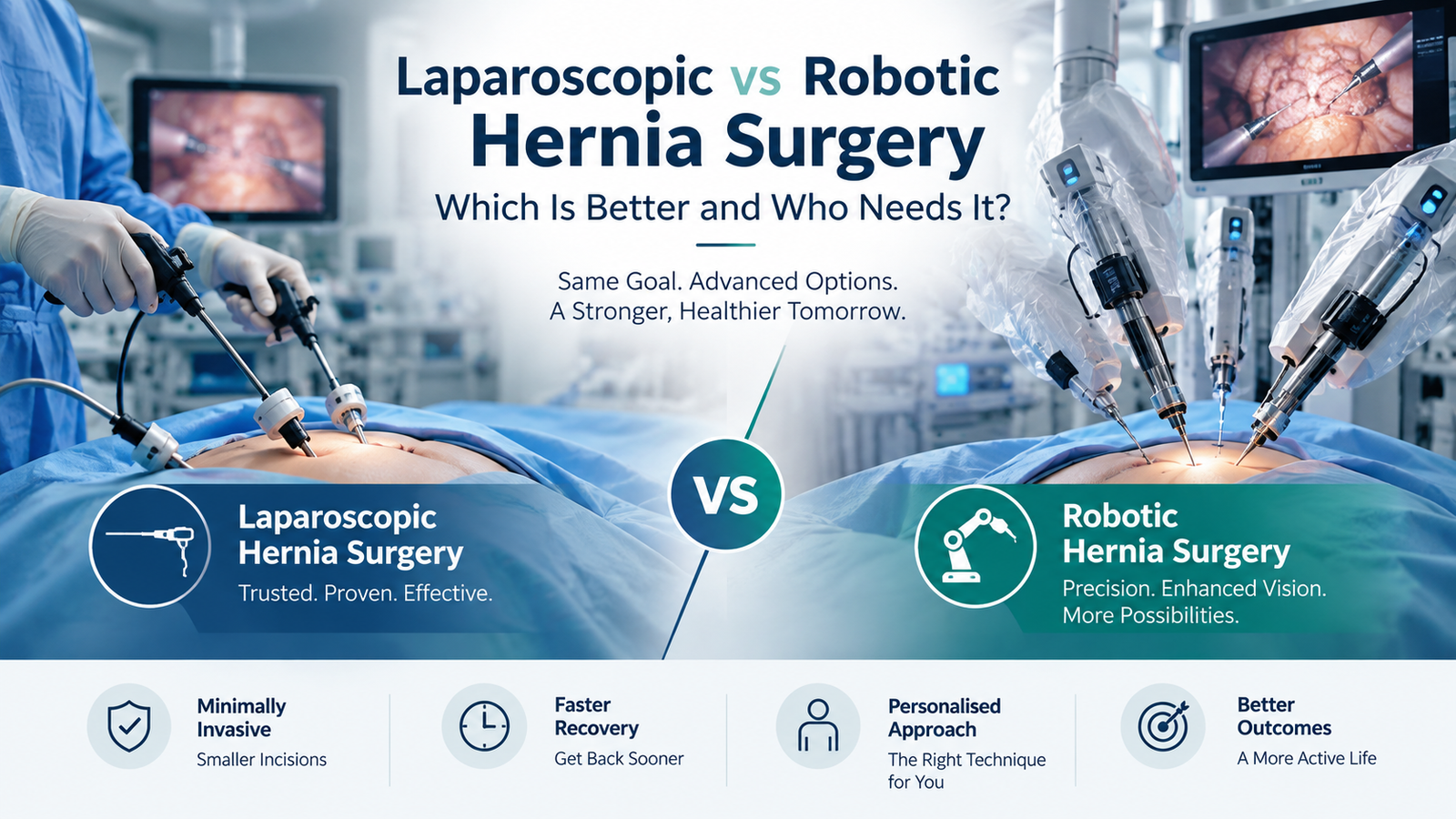
Laparoscopic vs Robotic Hernia Surgery: What Is the Main Difference?
Both are minimally invasive, but the surgeon interacts with the instruments differently.
In conventional laparoscopy, the surgeon stands beside the patient and directly manipulates long instruments while watching a monitor.
In robotic surgery, the surgeon operates from a console and controls articulated robotic instruments.
The difference can be understood simply:
Laparoscopy = surgeon directly controls laparoscopic instruments.
Robotic surgery = surgeon controls robotic instruments through a console.
Neither technique eliminates the need for surgical skill.
Laparoscopic vs Robotic Hernia Surgery: Quick Comparison
|
Factor |
Laparoscopic Hernia Surgery |
Robotic Hernia Surgery |
|
Approach |
Minimally invasive |
Minimally invasive |
|
Incisions |
Usually several small incisions |
Usually several small incisions |
|
Visualisation |
Magnified camera view |
Magnified 3D view on many systems |
|
Instruments |
Long laparoscopic instruments |
Articulating robotic instruments |
|
Surgeon control |
Direct instrument manipulation |
Console-controlled |
|
Suturing |
Effective but technically demanding |
Articulation may facilitate complex suturing |
|
Routine hernias |
Well-established option |
Can also be performed |
|
Complex reconstruction |
Possible in experienced hands |
May provide technical advantages in selected cases |
|
Hospital stay |
Often short |
Often short |
|
Recovery |
Generally faster than traditional large-incision surgery |
Generally similar minimally invasive recovery |
|
Operating time |
Often shorter in comparative studies |
Can be longer |
|
Cost |
Generally lower |
Generally higher |
|
Best choice |
Depends on patient and hernia |
Depends on patient and hernia |
This table should not be interpreted as a recommendation for one operation over the other.
Is Robotic Hernia Surgery Better Than Laparoscopic Surgery?
Not automatically.
This is probably the most important point in this article.
Current research comparing robotic and laparoscopic inguinal hernia repair generally shows that both approaches can provide comparable clinical outcomes.
Recent randomized evidence has not demonstrated a clear overall advantage of robotic repair in complications, recurrence or same-day discharge.
Robotic surgery does, however, provide technical advantages to the surgeon, including articulated instruments and improved ergonomics, which may be useful in particular situations.
So instead of asking:
“Is robotic surgery better?”
A more clinically meaningful question is:
“Does robotic technology provide a meaningful advantage for this particular operation?”
For a straightforward hernia, an experienced laparoscopic surgeon may achieve an excellent repair without needing a robotic platform.
For a more complicated abdominal-wall reconstruction, the additional dexterity of robotic instruments may sometimes be useful.
When May Laparoscopic Hernia Surgery Be a Good Option?
Laparoscopic surgery has been used successfully for hernia repair for decades.
Depending on individual circumstances, it may be considered for:
- Inguinal hernia
- Bilateral inguinal hernias
- Selected recurrent hernias
- Ventral hernia
- Selected incisional hernias
- Other abdominal-wall hernias
One advantage of laparoscopic surgery is the ability to examine the groin or abdominal wall internally through small incisions.
For bilateral groin hernias, for example, both sides can potentially be addressed using the same port access.
Laparoscopy is also widely available and generally less costly than robotic surgery.
For many routine hernias, there may be no compelling reason to use a robot simply because one is available.
When May Robotic Hernia Surgery Be Considered?
Robotic surgery may be particularly attractive when the operation requires extensive suturing, careful tissue-plane dissection or more complex abdominal-wall reconstruction.
Examples in which robotic surgery may be considered include selected:
- Ventral hernias
- Incisional hernias
- Recurrent hernias
- Complex abdominal-wall defects
- Hernias requiring extensive suturing
- Cases involving difficult anatomy
This does not mean that every complex hernia must be repaired robotically.
Many complex hernias can also be treated successfully using laparoscopic or open techniques by appropriately experienced surgeons.
The operation should be selected for the patient rather than the patient being selected for a particular machine.
What About Inguinal Hernia: Robotic or Laparoscopic?
For routine inguinal hernia repair, laparoscopic surgery remains a very well-established minimally invasive approach.
Common minimally invasive techniques include:
TEP – Totally Extraperitoneal Repair
The repair is performed without entering the main abdominal cavity.
TAPP – Transabdominal Preperitoneal Repair
The surgeon enters the abdominal cavity and then accesses the preperitoneal space where the mesh is positioned.
Robotic inguinal hernia repair is frequently performed using a robotic TAPP approach.
Research comparing robotic and laparoscopic inguinal repair has generally found broadly comparable safety and clinical outcomes.
Therefore, a patient with an uncomplicated inguinal hernia should not assume that robotic surgery is necessary for a successful repair.
What About Incisional Hernia?
Incisional hernias can vary enormously.
A small defect following a previous keyhole surgery is very different from a large abdominal-wall hernia after multiple major operations.
Treatment planning may depend on:
- Size of the defect
- Number of defects
- Previous mesh
- Scar tissue
- Previous infection
- Muscle separation
- Obesity
- Location
- Quality of abdominal-wall tissue
For selected incisional hernias, robotic technology can help surgeons perform complex suturing and reconstruction through a minimally invasive approach.
However, evidence comparing robotic and laparoscopic incisional hernia repair has not demonstrated universal superiority of one technique.
Some studies have reported shorter hospital stay with robotic repair but longer operating times.
Therefore, complexity and anatomy should guide the decision.
What About Recurrent Hernia?
A recurrent hernia deserves careful evaluation.
Before operating, the surgeon needs to understand:
- What operation was performed previously?
- Was mesh used?
- Where was the mesh positioned?
- Why might the repair have failed?
- Is infection present?
- How large is the recurrent defect?
- What tissue planes remain available?
Sometimes changing the surgical approach can be advantageous.
For example, a recurrent groin hernia after an anterior open repair may be approached from a posterior minimally invasive plane in appropriate patients.
Robotic surgery may also be useful in selected complex recurrent cases because of the enhanced instrument articulation.
But again, recurrence alone does not automatically mean that robotic surgery is required.
Does Robotic Surgery Mean Smaller Cuts?
Not necessarily significantly smaller than laparoscopy.
Both approaches use small port incisions.
Patients sometimes expect robotic surgery to be virtually incision-free. That is not correct.
Ports still have to enter the abdomen, and the number and size depend on the procedure and robotic platform.
The major comparison in terms of incision size is generally:
Open surgery versus minimally invasive surgery, rather than robotic versus laparoscopic surgery.
Which Surgery Causes Less Pain?
This is another area where marketing claims can exceed the evidence.
Both laparoscopic and robotic surgery are minimally invasive and can be associated with relatively favourable postoperative recovery.
Some individual studies have reported differences in pain, but current pooled evidence has not established a consistent major pain advantage for robotic inguinal hernia repair.
Pain after hernia surgery depends on many factors besides the platform used:
- Hernia size
- Type of repair
- Tissue dissection
- Mesh position
- Fixation method
- Nerve irritation
- Patient pain sensitivity
- Previous surgery
- Postoperative activity
It is therefore inappropriate to promise “painless robotic hernia surgery.”
No hernia operation is guaranteed to be pain-free.
Which Has Faster Recovery?
For many uncomplicated minimally invasive repairs, recovery can be relatively quick with either technique.
Patients may be able to walk on the day of surgery and progressively resume routine activities according to their surgeon’s advice.
However, recovery depends more on the extent of the actual operation than whether the instruments were robotic or laparoscopic.
A simple laparoscopic groin hernia and a complex robotic abdominal-wall reconstruction should not be compared simply because both use small incisions.
Recovery is influenced by:
- Hernia complexity
- Size
- Repair technique
- Patient age
- Fitness
- Obesity
- Diabetes
- Smoking
- Previous operations
- Complications
Patients should follow individual postoperative instructions rather than fixed internet timelines.
Which Has a Lower Risk of Hernia Recurrence?
This is an important question.
The latest research does not provide strong enough evidence to say that robotic surgery universally prevents recurrence better than laparoscopic surgery.
Some observational analyses have reported lower recurrence with robotic inguinal repair, but the certainty of that evidence is low. Randomized evidence has not established a clear recurrence advantage.
More importantly, recurrence is influenced by many factors:
- Correct surgical technique
- Adequate dissection
- Appropriate mesh selection and positioning
- Defect closure when indicated
- Hernia complexity
- Obesity
- Smoking
- Tissue quality
- Wound infection
- Previous repairs
- Patient activity and healing factors
The surgical platform is only one part of the equation.
Does Robotic Surgery Take Longer?
Often, yes.
Recent comparative studies have frequently reported longer operating times for robotic inguinal hernia repair.
This can relate to:
- Robotic setup
- Docking
- Instrument exchange
- Complexity of procedures selected for robotics
- Surgical-team experience
Operating time can improve as a surgical team gains experience, but current evidence still commonly shows longer procedural times with robotic repair.
A longer operation does not automatically mean a worse operation, particularly if the robot enables a more complex repair to be completed minimally invasively.
It simply needs to be considered as part of the overall decision.
Is Robotic Hernia Surgery More Expensive?
Generally, yes.
Robotic surgery requires expensive technology, specialised instruments, maintenance and trained teams.
Current comparative studies consistently identify higher procedural costs for robotic inguinal hernia repair.
Whether that additional cost is justified depends on whether robotic technology offers a meaningful clinical or technical advantage in the particular patient’s operation.
For a complex case, that value equation may differ from a straightforward unilateral hernia.
Patients should ask about expected costs before deciding.
Does Robotic Surgery Reduce Complications?
There is currently no strong evidence that robotic repair universally reduces complications compared with laparoscopic repair.
Potential complications of hernia surgery can include:
- Bleeding
- Infection
- Seroma
- Hematoma
- Urinary retention
- Injury to surrounding structures
- Persistent pain
- Mesh-related problems
- Recurrence
The exact risks depend on the type of hernia and operation.
Large contemporary analyses generally show similar overall complication profiles between robotic and laparoscopic approaches for inguinal hernia repair.
What Is Mesh and Is It Used in Both Procedures?
Mesh is a medical implant used to reinforce weakened tissue.
It is commonly used in many adult hernia repairs because simply stitching weakened tissue together can place significant tension on the repair.
Mesh can be used during:
- Open surgery
- Laparoscopic surgery
- Robotic surgery
The important issues include:
- Whether mesh is appropriate
- Type of mesh
- Size
- Position
- Adequate overlap
- Fixation method when needed
- Patient-specific risk factors
Robotic surgery does not mean “mesh-free surgery.”
If avoiding mesh is important to you, discuss this specifically with your surgeon.
Can a Large Hernia Be Repaired Robotically?
Some large or complex hernias can be repaired robotically, but not every large hernia should be.
Complex abdominal-wall reconstruction may require advanced techniques to restore the function and anatomy of the abdominal wall.
In selected patients, robotic technology may allow some of these manoeuvres to be performed minimally invasively.
However, very large defects, loss of abdominal domain, extensive scar tissue, infection or other factors may make an open or hybrid operation more appropriate.
Choosing open surgery in such a situation is not a failure of minimally invasive surgery.
It may be the safest and most effective approach.
Can Robotic Surgery Convert to Open Surgery?
Yes.
The same is true for laparoscopic surgery.
Occasionally, unexpected anatomy, severe adhesions, bleeding, difficulty visualising structures or another safety concern may require conversion to open surgery.
Conversion should not automatically be considered a surgical failure.
Patient safety takes priority over completing an operation through small incisions.
What Are the Advantages of Laparoscopic Hernia Surgery?
Potential advantages include:
- Small incisions
- Established surgical technique
- Magnified operative view
- Ability to treat selected bilateral hernias through the same access
- Potentially quicker recovery than some open approaches
- Wide availability
- Generally lower cost than robotic surgery
- Extensive long-term surgical experience and evidence
Its limitations include rigid instruments and technically demanding intracorporeal suturing in certain complex operations.
What Are the Advantages of Robotic Hernia Surgery?
Potential technical advantages include:
- Three-dimensional magnified visualisation
- Articulating instruments
- Greater freedom of movement
- Improved ergonomics for the surgeon
- Facilitation of complex intracorporeal suturing
- Potential ability to perform selected complex reconstructions minimally invasively
Potential limitations include:
- Higher cost
- Availability
- Longer operating time in many studies
- Requirement for specific surgical-team training
- Lack of evidence showing universal clinical superiority over laparoscopy
These benefits and limitations should be discussed rather than presenting robotics as automatically “advanced and therefore better.”
Is the Robot More Important Than the Surgeon?
No.
This is something patients should understand clearly.
A robotic platform is a surgical tool.
So is a laparoscopic system.
The quality of a hernia repair depends on:
- Accurate diagnosis
- Appropriate procedure selection
- Understanding of anatomy
- Surgical judgement
- Technical expertise
- Experience with the chosen technique
- Proper mesh placement when indicated
- Recognition and management of complications
- Postoperative care
A sophisticated machine cannot compensate for poor surgical decision-making.
For patients, the question should not simply be:
“Does the hospital have a robot?”
It should also be:
“How experienced is my surgeon in treating my type of hernia?”
How Does a Surgeon Decide Between Laparoscopic and Robotic Surgery?
Several factors are considered.
- Type of hernia
Inguinal, umbilical, ventral and incisional hernias have different anatomical considerations.
- Size
A tiny primary defect and a large abdominal-wall defect require very different operations.
- Simple or complex
Complexity can be more important than size alone.
- Primary or recurrent
Previous surgery can significantly alter the surgical planes.
- Previous abdominal operations
Scar tissue and adhesions may affect access.
- Need for reconstruction
Some abdominal-wall defects require extensive suturing or reconstruction.
- Patient factors
Age, obesity, diabetes, smoking, heart/lung disease and overall fitness matter.
- Surgeon expertise
The surgeon should be proficient in the technique selected.
- Hospital resources
Not every centre has access to a robotic platform or a trained robotic surgical team.
- Cost
Cost should be discussed when two clinically reasonable options are available.
Laparoscopic vs Robotic Hernia Surgery: Which Is Better?
For many patients, there is no universal winner.
Laparoscopic surgery may be an excellent choice when:
- The hernia is suitable for a conventional minimally invasive repair
- The surgeon has extensive laparoscopic experience
- Robotic articulation offers little additional clinical value
- Cost is an important consideration
Robotic surgery may be considered when:
- Complex suturing is required
- The anatomy is difficult
- Abdominal-wall reconstruction is needed
- The surgeon believes robotic articulation provides a meaningful technical advantage
- The centre has appropriate expertise and infrastructure
Open surgery may still be better when:
- The hernia is extremely large or complex
- There are particular anatomical considerations
- Previous operations make minimally invasive access unsuitable
- Infection or other clinical factors influence mesh or reconstruction strategy
- Patient factors favour an open approach
Good surgery means selecting the right operation—not automatically selecting the newest technology.
What Should You Ask Your Surgeon Before Hernia Surgery?
Patients considering surgery should ask:
- What type of hernia do I have?
- How large is the defect?
- Do I need surgery now?
- What happens if I wait?
- Do you recommend open, laparoscopic or robotic repair?
- Why do you recommend this approach for me?
- Will mesh be required?
- Where will the mesh be positioned?
- What are the risks?
- What is the chance of recurrence?
- How much pain should I expect?
- How soon can I walk normally?
- When can I return to work?
- When can I exercise or lift weights?
- What is your experience with this type of hernia?
- Is robotic surgery likely to provide a meaningful advantage in my case?
The answer to question 16 is particularly important.
Robotic surgery should ideally be chosen because it provides a clinical or technical benefit—not merely because the technology is available.
Frequently Asked Questions
Is robotic hernia surgery better than laparoscopic surgery?
Not for every patient. Current evidence shows broadly comparable outcomes for many inguinal hernia repairs. Robotic surgery can provide technical advantages in selected complex procedures.
Is robotic hernia surgery safer?
Both can be safe when performed appropriately. Current evidence has not demonstrated a universal reduction in complications with robotic surgery.
Which surgery has less pain?
Both are minimally invasive. Research has not established a consistent major pain advantage for robotic surgery across patients.
Which has faster recovery?
Recovery can be similar for comparable minimally invasive operations. The complexity of the hernia and extent of surgery are often more important than the platform.
Which has a lower recurrence rate?
High-quality randomized evidence has not established a clear recurrence advantage for robotic over laparoscopic inguinal hernia repair.
Is robotic surgery more expensive?
Generally yes. Comparative studies consistently report higher procedural costs for robotic hernia repair.
Does the robot perform the surgery?
No. The surgeon controls the robotic system throughout the operation.
Is mesh used in robotic hernia surgery?
Mesh is commonly used in many robotic, laparoscopic and open adult hernia repairs when appropriate.
Can an inguinal hernia be repaired laparoscopically?
Yes. Laparoscopic TEP and TAPP are established minimally invasive approaches for suitable inguinal hernias.
Is robotic surgery useful for recurrent hernia?
It can be useful in selected recurrent or complex hernias, but recurrence alone does not mean robotic surgery is required.
Can I go home on the same day?
Many uncomplicated hernia repairs can involve short hospital stays or same-day discharge, but this depends on the operation, anaesthesia, patient condition and hospital protocol.
Can a hernia return after robotic surgery?
Yes. No repair technique can guarantee zero recurrence.
The Bottom Line
The debate about laparoscopic vs robotic hernia surgery should not be reduced to which technology is newer.
Both are advanced minimally invasive surgical approaches.
Laparoscopic hernia surgery is well established, widely used and highly effective for appropriately selected patients.
Robotic surgery adds three-dimensional visualisation, articulated instruments and enhanced dexterity that may be particularly useful for certain complex repairs and abdominal-wall reconstructions.
However, current evidence does not support telling every patient that robotic surgery is clinically superior.
For a straightforward hernia, conventional laparoscopic surgery may provide everything required for an excellent repair.
For a complex hernia, robotic technology may sometimes give an experienced surgeon additional technical options.
And in certain patients, open surgery may still be the most appropriate choice.
The best hernia operation is therefore not necessarily the most technologically advanced one. It is the operation that safely and effectively addresses the individual patient’s hernia.
About Dr. B. D. Pathak
Dr. B. D. Pathak is Senior Director – GI, Minimal Access & Bariatric Surgery at Fortis Escorts Hospital, Faridabad. His clinical work includes laparoscopic and general surgery, including hernia surgery and other minimally invasive gastrointestinal procedures.
For publication, use only Dr. Pathak’s current verified hospital profile for qualifications, experience, procedure numbers and awards.
Medical Disclaimer
This article is intended for patient education and general information. It does not replace individual medical evaluation or surgical advice. The appropriate approach to hernia repair depends on the type of hernia, anatomy, symptoms, medical history and clinical assessment.








 WhatsApp Us